
Planning to move to Mexico from the USA? Discover visa requirements, residency options for workers, remote professionals and retirees, tax rules and step-by-step relocation advice for 2026.
H1 — Move to Mexico from USA: Complete Residency Guide for Workers, Remote Professionals and Retirees (2026)
For many Americans, moving to Mexico is no longer just a dream.
It has become a real and strategic life choice.
Some people are looking for a better lifestyle and lower monthly costs, others want to continue working remotely while enjoying a higher quality of life, and many retirees are choosing Mexico as one of the best places in the world to spend their retirement years.
Mexico offers something that very few countries can match:
proximity to the United States, affordable living, quality private healthcare and an extraordinary diversity of cities and lifestyles.



From the colonial elegance of San Miguel de Allende to the modern business atmosphere of Querétaro, and the relaxed coastal life of Mérida, Mexico continues to attract thousands of U.S. citizens every year.
But before planning housing, taxes, schools or healthcare, there is one crucial step:
obtaining legal residency.
In this guide, we explain exactly how U.S. citizens can legally move to Mexico in 2026.
H2 — Do Americans Need a Visa to Move to Mexico?
Yes — if you plan to live in Mexico for more than 180 days.
Entering as a tourist is not the same as becoming a legal resident.
This is one of the most common misunderstandings.
Many people assume that because U.S. citizens can easily enter Mexico as visitors, they can later “convert” that stay into legal residency.
In most cases, this is incorrect.
Residency usually begins outside Mexico, through a Mexican consulate in the United States, and must then be finalized inside Mexico with the immigration office (INM).
The two most important residency categories are:
- Temporary Resident Visa → valid up to 4 years
- Permanent Resident Visa → indefinite stay
H2 — Best Residency Option for Working Professionals
If you are moving because you have been hired by a Mexican company, the process must start with the employer.
The company must sponsor the application through Mexico’s immigration system.
This route is ideal for:
- executives
- engineers
- hospitality professionals
- real estate professionals
- international corporate transfers
The employer submits the work authorization request to the INM and obtains the NUT number.
Only after this approval can the applicant attend the consular appointment in the U.S.
This is the only correct route for legal employment in Mexico.
Entering as a tourist and working locally can create immigration and tax issues later.
H2 — Can Americans Work Remotely from Mexico?
Absolutely yes.
This is currently one of the most searched topics on Google.
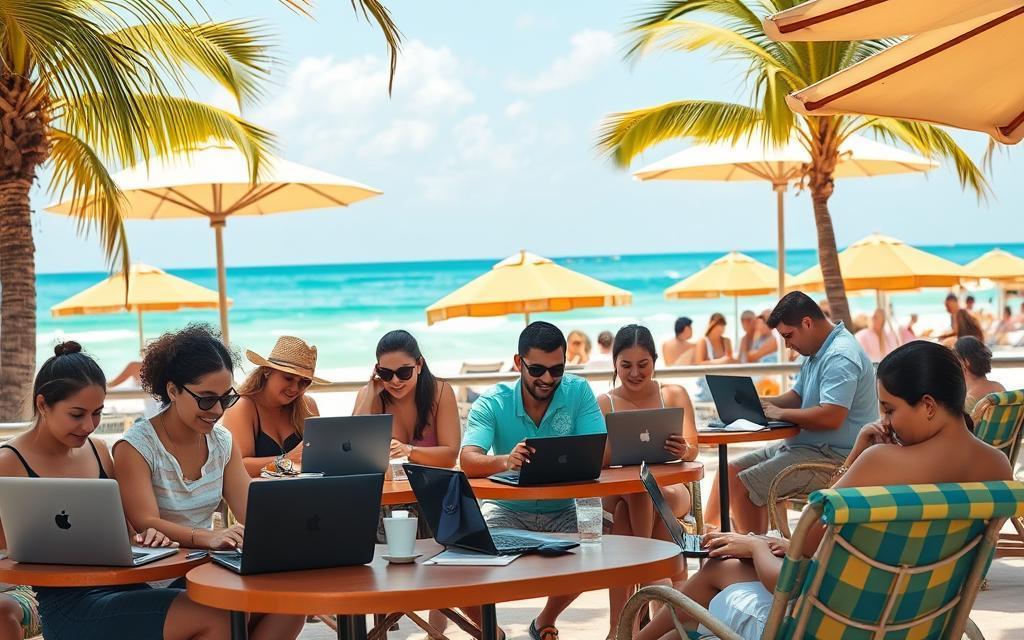
The good news is that many Americans legally relocate to Mexico while continuing to work for U.S. companies.
Mexico does not currently offer an official “digital nomad visa,” but the most common route is the Temporary Resident Visa based on economic solvency.


This means you must demonstrate:
- stable monthly income
- U.S.-based employment
- consistent payroll history
- sufficient bank balances
For 2026, many consulates are using thresholds around USD 4,300–4,600 monthly income or strong savings balances.
This route is ideal for:
- consultants
- IT professionals
- freelancers
- digital entrepreneurs
- remote employees
H2 — Retire in Mexico from USA: Residency Requirements
Mexico remains one of the top retirement destinations for Americans.
More and more retirees are choosing cities such as Mérida, Puerto Vallarta and San Miguel de Allende.



For retirees, the best option is often Permanent Residency.
This allows indefinite stay without renewals.
Financial requirements generally include proof of:
- pension income
- Social Security
- investment distributions
- retirement savings
- 401(k) income
Many 2026 sources indicate thresholds around USD 4,300–4,500 monthly income or higher depending on the consulate.
H2 — Important Tax Considerations for U.S. Citizens
Moving to Mexico does not remove U.S. tax obligations.
U.S. citizens must continue filing with the Internal Revenue Service even while living abroad.
At the same time, if you spend more than 183 days per year in Mexico, you may also become a Mexican tax resident.
This means dual compliance planning is essential.
Topics usually include:
- FEIE
- FTC
- treaty considerations
- pension taxation
- rental income
- Mexican RFC registration
This is often where relocation clients most need professional support.
H2 — Why Professional Relocation Support Makes the Difference
A successful move is never only about immigration paperwork.
Clients usually need support for:
- residency strategy
- tax orientation
- rental contracts
- property purchase
- banking
- healthcare
- school search
- vehicle importation
This is where our service positioning becomes powerful.
H2 — Ready to Move to Mexico? Let’s Build Your Relocation Plan
Moving to Mexico should feel exciting, not overwhelming.
Whether you are:
- relocating for work
- moving as a remote professional
- retiring from the U.S.
we help you design the right legal and practical strategy.
CTA — Book Your Personalized Mexico Relocation Consultation
We provide full assistance with:
- visa and residency planning
- document review
- relocation support
- housing assistance
- tax orientation
- local settling services
Book your consultation today and start your move to Mexico with confidence. +16503037404 ( whatsapp ) or rivieramauablue@gmail.com




Nessuna risposta.